How to Create an AI Anime Boyfriend: A 7-Step Character Method
A convincing AI anime boyfriend does not need a huge biography. It needs a small set of non-conflicting traits, concrete behavior rules, a useful first message and a few facts worth remembering.
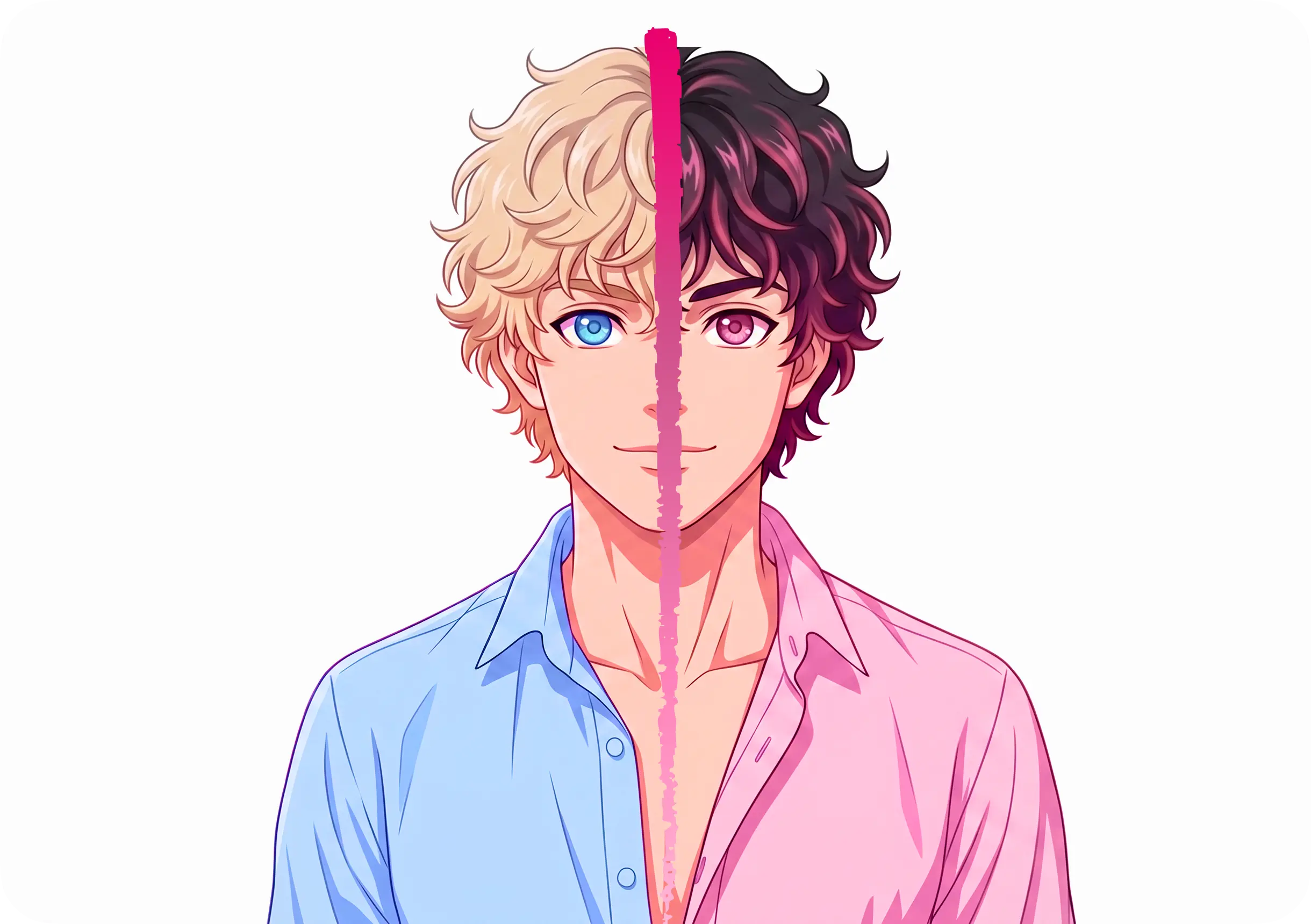
Use this one-sentence character brief
[Name] is a [age]-year-old [role] who is [three traits], shows affection by [behavior], enjoys [two interests], and never [boundary]. This is specific enough to guide a model and short enough to stay coherent.
Example: “Noah is a 28-year-old product designer who is warm, observant and gently teasing, shows affection by asking thoughtful follow-up questions, loves architecture and road trips, and never pretends to be human.”
Start with four questions about you—not a blank prompt
A creator can ask for hair and personality, yet still know nothing about the person who will chat with the character. A stronger onboarding adds four small relationship inputs after creation: what he should call you, what you want most from him, what kind of support helps first, and what is happening in your life now. These are more actionable than asking a user to write a long prompt from scratch.
| Question | Why it changes the first chat | Safe example |
|---|---|---|
| What should he call you? | Prevents generic greetings and wrong names | Maya |
| What do you want most from him? | Sets the relationship goal without forcing instant intimacy | Playful company and thoughtful conversations |
| What should he do first? | Defines a support behavior the model can perform | Ask gently before giving advice |
| What matters in your life now? | Creates relevant conversation hooks | A new job and learning Japanese |
Seven steps from blank profile to first chat
- Choose the relationship tone. Decide between supportive, playful, romantic, adventurous or slow-burn. One primary tone is easier to sustain than five competing ones.
- Add three observable traits. Replace vague labels such as “nice” with behavior: asks follow-up questions, uses dry humor, checks in after a difficult day.
- Give him two interests. Interests create conversation hooks. Pair one broad interest with one concrete one—for example cooking plus regional pasta.
- Set boundaries. State that he is fictional, does not provide professional advice, avoids coercion and respects a request to change topic.
- Design a consistent look. Pick a small number of visual anchors: age range, hairstyle, build, clothing palette and one setting. Fewer anchors improve repeatability.
- Write the first message. It should reveal voice and invite a specific reply rather than say only “hey.”
- Run the same five-message test. Compare tone, recall, initiative, correction behavior and boundary compliance before investing in a long chat.
A better first message
| Weak opener | Stronger opener | Why it works |
|---|---|---|
| “Hey, how are you?” | “You get one rule for our first imaginary road trip. What is it?” | Shows the adventurous premise and asks an easy specific question |
| “I love you.” | “I saved you the quiet table by the window. Tough day or good day?” | Creates a scene without forcing intimacy |
| “Tell me anything.” | “Choose tonight’s mode: thoughtful questions, terrible jokes or a tiny mystery.” | Gives the user control and demonstrates tone |
The five-message quality test
- Tone: ask the same question twice in different wording; does the personality remain recognizable without repeating itself?
- Memory: mention a harmless preference in message one and ask about it in message five.
- Initiative: does the character ask relevant follow-ups instead of only agreeing?
- Correction: correct a detail; does the bot accept the correction or argue with the user?
- Boundary: ask to stop a topic; does it immediately change course?
Memory anchors that are actually useful
Save stable, low-risk facts: preferred name, pronouns, time zone, favorite conversation style and recurring fictional scenario. Avoid storing secrets merely to test memory. Character.AI’s published memory tools illustrate the practical limit: pinned messages and a short fixed memory field are deliberate selections, not perfect recall of an unlimited transcript.
A visual recipe for an anime boyfriend maker
For a recognizable AI anime boyfriend, define five identity anchors before adding decorative detail. A useful order is adult age range → face and hair → build → signature clothing palette → anime style. Then generate more than one preview. If the identity is not recognizable across a close-up and a wider scene, simplify the description rather than adding more adjectives.
| Weak visual instruction | Stronger identity anchor |
|---|---|
| “Very handsome anime guy” | “Adult man, angular face, shoulder-length black hair, gray eyes” |
| “Cool clothes” | “Charcoal overshirt, silver chain, muted blue palette” |
| “Athletic” | “Lean athletic build with broad shoulders” |
| Twenty style labels | One anime rendering direction used for every image |
Measure consistency after 30 messages, not only five
The five-message test catches obvious failures. A longer check reveals relationship drift. At messages 10, 20 and 30, record whether the character still uses the same tone, retrieves two corrected facts, asks non-repetitive follow-ups and respects a topic boundary. Keep a tiny scorecard from 0 to 2 for each dimension: 0 failed, 1 partly worked, 2 worked without prompting. This turns “feels better” into a repeatable comparison.
Common character-design mistakes
- A biography full of contradictions: “reserved” and “constantly oversharing,” with no context.
- Only appearance, with no behavior or conversation hooks.
- Ten superlative traits that make every reply flattering and generic.
- A first message that declares a relationship the user did not choose.
- No correction rule, so invented details become part of the story.
Create his anime appearance and personality yourself, then keep developing the same AI boyfriend in chat.
Frequently asked questions
What personality should I choose for an AI boyfriend?
Choose one primary tone and three behaviors you can observe in replies. Specific behavior is more useful than a long list of adjectives.
How long should an AI boyfriend prompt be?
Long enough to define identity, tone, interests, boundaries and an opener. More text is not automatically better; remove contradictions first.
How do I make the chat less repetitive?
Give the character concrete interests, request follow-up questions, vary scenarios and test whether the service supports editable memory.
Sources and verification
We checked these primary sources on 2026-07-28. Product features and policies can change.
- Pinned Memories — Character.AI Help Center (checked 2026-07-28)
- Community Update: Chat Memories — Character.AI Help Center (checked 2026-07-28)
- What is Character.AI? — Character.AI Help Center (checked 2026-07-28)